
 Axel Quack
Atomic, hard-to-break systems. Bluefin sits in that family — with a sharper AI story than “no agents allowed.”
Three questions, in order:
- What is a malleable OS?
- What does one look like when it ships — Omarchy 4?
- How does Bluefin answer the same “malleable computer” problem from the other side — and when is each the right agentic desktop?
Most “agent OS” writing starts with a chat product and never defines the material. This piece starts at malleable versus immutable.
Malleable OS
The claim
Malleable is not a standards-body acronym. It is a design claim: software should be formable under pressure without shattering — like metal under a hammer — so the user can reshape behaviour in the course of work.
Ink & Switch name the modern problem cleanly: we live in software spaces that are, ironically, less flexible than physical workshops. Apps arrive prefabricated. When something does not fit, we file feedback and contort the workflow. Their programme — malleable software — asks for environments where anyone can adapt tools with minimal friction, not only vendors shipping quarterly releases. Related lab threads (local-first data, programmable documents, richer version control for creative work) climb the same ladder: agency over the shape of the tool.
A malleable OS is what happens when that claim reaches the desktop stack: not only a document becomes formable — the window manager, launcher, package surface, and agent chrome do too.
What it is not
| Soundalike | Why it fails the test |
|---|---|
| “Has an AI button” | Copilot on a locked DE is suggestion, not ownership of shape |
| “Many themes” | Cosmetics without behavioural reach |
| “Open source somewhere” | If the durable shape is still vendor-owned, you are a tenant |
| “Configurable” | Three nested toggles ≠ reshape-in-the-flow-of-work |
| “Ships many AI CLIs” | Necessary but not sufficient — where they are allowed to write matters |
Malleable means the durable shape of the system is user-owned and agent-reachable — configs, plugins, keybindings, local tools, TUIs — and changes land as artifacts you can diff, roll back, and fork.
Why Linux is the practical substrate
DHH’s “malleable computer” rhetoric lands on Linux for a structural reason: from kernel through compositor to apps, the stack is inspectable and replaceable. On a closed desktop, AI can propose; it cannot honestly own the chrome. On Arch/Hyprland-class systems, an agent’s change is a file under ~/.config and a package in a graph you already understand. On Fedora Atomic-class systems, the base refuses that honesty on purpose — and pushes malleability into home, brew, Flatpak, and containers.
Five properties (score any candidate)
- Reach — behaviour that matters is changeable (WM, bar, tools), not only wallpapers
- Locality — changes live in user-owned paths/repos you can export
- Reversibility — snapshots, rebases, config reinstall, git history
- Composability — plugins, TUIs, packages, containers without a single sealed store
- Legibility — a second human or agent can read what changed
Malleable vs immutable (the strategic fork)
| Malleable | Immutable | |
|---|---|---|
| Base | Mutable, user-writable system | Atomic / read-only base image |
| Failure mode | Agent or human bricks config fast | Surprise is hard; DE invention is slower |
| Recovery | Snapshots, git, reinstall configs | Rebase/rollback of the image |
| Example posture | Omarchy-class Arch desktop | Bluefin-class Fedora Atomic |
| Cluster cousin | — | Talos (no SSH culture) |
Flag theory wants both postures assigned on purpose: full host malleability for invention; immutability for calm and sealed labs. One ideology on every machine is how you either freeze or self-own.
Malleable OS as Agent OS
If “Agent OS” means anything rigorous, it is the stack that turns model intent into durable side effects under policy. A desktop becomes an Agent OS when:
- agents are first-class (launchers, telemetry, crash paths), not sidebar toys
- the surfaces that define the machine are agent-reachable or deliberately fenced
- skills or docs teach layout so the model is not guessing paths
- reversibility exists so power does not mean irreversible vandalism
Omarchy maximises reach on the host. Bluefin maximises reversibility of the host and still runs a serious agent stack — malleability at the edges, not in the base image.
Omarchy 4 Quattro: full host malleability as product
Omarchy is an omakase Arch setup by DHH / 37signals: Hyprland tiling, keyboard-first, opinionated defaults, MIT, basecamp/omarchy. Through 3.x, “dotfiles in a trench coat” was a fair jab. 4.0 Quattro (mid-August 2026) is where that jab weakens: pacman-packaged system pieces, a from-scratch Quickshell desktop (large QML surface), and an explicit bet that coding agents belong in the chrome of the OS.
Agents as system citizens
| Citizen feature | Why it is OS-shaped, not app-shaped |
|---|---|
| Many agent CLIs as first-class launchers | Claude, Codex, Gemini, Grok, … — lazy-loaded, multi-vendor |
| Bar telemetry | Plan limits, token burn, cross-machine usage — ops in the panel |
| Crash → agent | Core dumps offered to the coding agent with machine context |
| Shipped Omarchy skill | Teaches how this machine is laid out and how to reconfigure it (experimental on purpose) |
| Agent-aware terminal culture | Multiplexers/layouts built to watch agents; idle/working/blocked/done |
| Plugin architecture | Bar, menus, lockscreen, overlays as cloneable Quickshell widgets |
DHH’s line, paraphrased across release culture: ask the agent, and shortly afterward your operating system is extended. That is malleability with a concrete UX — the DE is in the blast radius on purpose.
Source: YouTube - Omarchy Quattro (DDH / official 4.0 launch).
Far beyond themes
Themes are the demo. With the Omarchy skill and plan-then-apply discipline, natural language reaches:
- Hyprland — gaps, keybindings, monitors, night light, window rules
- Quickshell — rebuild the top bar, clone widgets, command palettes
- New plugins — downloads, Tailscale, media, notifications, voice→agent, HUDs; community directories grow because generation cost collapsed
- System diagnosis — agent briefed on crashes
- Menus and shortcuts — Super+Space launcher entries that behave like apps
Durable edits belong in user-owned paths (~/.config, user plugins) so omarchy update does not erase your life. Config reinstall/rollback is part of the contract — formable, but recoverable.
TUIs as first-class apps
Install → TUI (or omarchy-tui-install) registers a terminal program as a launcher citizen: icon, name, command; optional chrome-less window. AI-written Ratatui/Textual/Go TUIs become apps: Clash managers, meeting record→transcript→summary, ebook readers, project scaffolders, QEMU helpers, ISO builders, focus timers. The boundary between “script I wrote” and “application I installed” collapses — malleable userland in one gesture.
Packages: native first
| Path | Role on Omarchy |
|---|---|
| Pacman | First-class; /usr integration; shared libs |
| AUR via yay | First-class fuzzy install; preview PKGBUILD |
| Flatpak / Flathub | DIY; sandbox when you want isolation |
| AppImage | Fine; register as TUI if desired |
Pacman apps are not containers. Fast, integrated, full user privilege. Depth over isolation. AUR quality varies; Wayland/Electron quirks are Hyprland-normal.
Scorecard (five properties)
| Property | Omarchy 4 |
|---|---|
| Reach | High — WM, bar, packages, TUIs, machine skill |
| Locality | High — ~/.config, user plugins, git-friendly |
| Reversibility | Medium–high — Btrfs snapshots, config reinstall; base is still mutable |
| Composability | High — Pacman/AUR/plugins/TUIs |
| Legibility | Medium — QML + Hyprland conf require literacy |
AI on a fully mutable host is a real risk
Omarchy invites models to mutate a mutable system:
- Configs, keybindings, scripts, plugins under user authority
- Quickshell plugins are not Flatpak sandboxes
- AUR is community code
- Auto-approve turns one bad prompt into a wide blast
- Machine skills that teach reconfiguration are root-adjacent in spirit
Mitigations: plan mode first; snapshots before ambitious runs; separate playground from vault/signing machine; read plugin/AUR provenance; turn agent chrome off when you need calm.
Bluefin: immutable base, malleability at the edges, Bluespeed agents
Bluefin (Universal Blue, Fedora Silverblue lineage) is the other opinionated Linux desktop in this conversation — and it is a mistake to dismiss it as “not malleable” or “anti-AI.” It answers the malleable computer problem with a different architecture: freeze the base, open the edges.
 CodingBite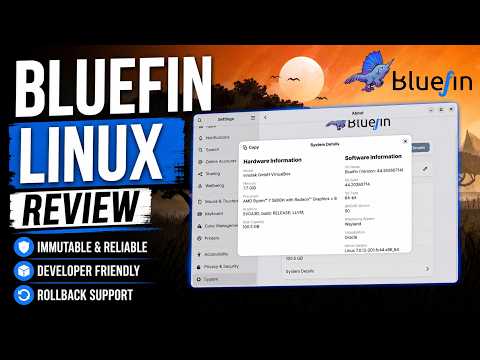
Source: YouTube - Bluefin Linux Review: Fedora's Most Reliable Linux Distro? (atomic uptates, rollback, containerised development).
What Bluefin optimises
- Atomic, largely read-only system image — updates are rebases; the OS is hard to permanently wreck
- Apps as Flatpak (and curated store culture) — isolation by default for GUI software
- Developer mutability outside the image — Homebrew (
brew/ujust bbrew), Distrobox/Toolbox, Podman/Docker, devcontainers - AI as OS-level endpoints you control — not a locked vendor assistant in the title bar
Official AI framing (Bluespeed): bring-your-own LLM, open-source-first tools, GPU acceleration included, foundation-aligned agent tooling (e.g. Goose from the Agentic AI Foundation orbit), local model runners (Ramalama, Docker Model Runner), desktop clients (Alpaca), Podman Desktop AI Lab. The OS should expose generic API endpoints for AI the user owns — cloud-native habits (bootc, podman) applied to agents.
Variants matter for posture: Bluefin / DX (dev), Aurora (KDE twin), GDX (NVIDIA/CUDA-oriented). Same immutable-base contract, different workloads.
Bluefin through the malleable-computer lens
Ink & Switch want agency over tools. Bluefin says: you may not rewrite the system image, but you get a full workshop in home, brew, and containers — and the base will still boot if the workshop explodes.
| Layer | Malleable? | How |
|---|---|---|
/usr, boot image |
No (by design) | Atomic updates; rpm-ostree / bootc family |
$HOME, dotfiles |
Yes | Classic Linux userland |
| CLI/dev tools | Yes | Homebrew brewfiles (ujust bbrew → AI, CLI, k8s, IDE bundles) |
| Pet Linux environments | Yes | Distrobox/Toolbox — full mutable userlands (including Arch) beside the immutable host |
| GUI apps | Mostly sandboxed | Flatpak; less “rewrite the DE,” more “install a confined app” |
| Local models | Yes | Ramalama / Docker Model Runner as user-controlled endpoints |
| Agents | Yes, fenced | Goose, OpenCode, Claude Code, Codex, etc. via brew/cask — strong on tasks, not on rewriting GNOME chrome as product thesis |
So Bluefin is a malleable computer if you measure malleability at the workflow and tool layer. It is not a malleable computer if you require the compositor and system image to be freely rewritten. Omarchy requires the second. Bluefin refuses it.
That refusal is the product. DHH’s Omarchy refuses the refusal.
Bluespeed vs Omarchy citizens
| Omarchy 4 citizens | Bluefin Bluespeed | |
|---|---|---|
| Product thesis | Agent extends the desktop | Agent uses the OS API / toolchain |
| First-class chrome | Bar token burn, crash→agent, machine skill, DE plugins | Curated AI brewfile, Goose, local model services, Flatpak AI apps |
| Where agent writes | Hyprland, Quickshell, Pacman/AUR, ~/.config |
$HOME, brew prefix, containers, project trees — not the ostree base |
| Failure mode | Broken bar/keybinds; snapshot boot | Broken container or home config; base still boots clean |
| Local LLM | Bring your own via agents | First-class Ramalama / Model Runner / Alpaca story |
| Isolation default | Low (native packages) | Higher (Flatpak + container culture) |
Neither is “more AI.” They locate agency differently: Omarchy in the shape of the desktop; Bluefin in the shape of the work while the desktop stays stable.
Scorecard (five properties)
| Property | Bluefin |
|---|---|
| Reach (host DE / base) | Low — intentional |
| Reach (tools, home, boxes) | High — brew, Distrobox, Podman, agents |
| Locality | High for user data and brew; base is image-local not “your fork of /usr” |
| Reversibility | Very high on the base (rebase/rollback); home still needs your own backup hygiene |
| Composability | High via containers and Flatpak; different texture than AUR plugins |
| Legibility | High for image state; container sprawl can become illegible if you never document boxes |
Bluefin’s malleable superpower: Distrobox
If you want Omarchy-like Arch mutability without giving up an immutable host:
- Run Bluefin as the daily driver.
- Spin Distrobox (or Toolbox) with an Arch (or Fedora) userland.
- Put experimental packages, aggressive agent experiments, and pet configs inside the box.
- Keep secrets and calm workflows on the host.
That is full malleability inside a boundary when the outer OS should not bend. It is also the honest answer to “can I have both?” — yes, stacked, not as one confused root.
AI risk on Bluefin (different shape)
Bluefin does not make agents harmless. An auto-approve coding agent can still:
- delete projects under
$HOME - exfiltrate tokens from env files
- wreck a Distrobox until you recreate it
- misuse cloud credentials
What it does make harder:
- permanently corrupting the system image with a bad host package operation
- “helpful” DE plugins running with the full trust of a fully mutable compositor stack
- AUR roulette on the machine that must just work on Monday
Immutability reduces class of failure. It does not remove judgment.
Omarchy vs Bluefin: full comparison
| Dimension | Omarchy 4 | Bluefin (DX/GDX) |
|---|---|---|
| Base | Mutable Arch | Fedora Atomic / Universal Blue |
| DE thesis | Hyprland + Quickshell, agent-native chrome | GNOME (Bluefin) / KDE (Aurora), stable chrome |
| Malleable computer answer | Yes — rewrite the host desktop | Yes — reshape tools and boxes, not the base image |
| Agentic OS flavour | Desktop-as-agent-control-plane | OS-as-AI-endpoint-provider + fenced agents |
| Package default | Pacman + AUR | Flatpak + brew + containers |
| Local models | Via whatever you install | Bluespeed first-class (Ramalama, Model Runner, Alpaca) |
| Best for | Invention, DE craft, multi-agent terminal theatre | Calm ops, long uptime, “Chromebook soul + real dev power” |
| Worst for | Unsupervised auto-approve on your only machine | Wanting the agent to redesign the desktop as a product feature |
| Recovery | Snapshot / config rollback | Image rebase; recreate boxes |
| Kinship | Classic Arch power-user | Silverblue / bootc / cloud-native desktop |
When to choose which (agentic workstation)
Choose Omarchy when the work is shaping the environment: tiling craft, plugin/TUI invention, agents as pair-programmers for the machine itself, you enjoy Arch texture and accept snapshot discipline.
Choose Bluefin when the work uses the environment: long coding sessions, local LLMs, k8s/cli toolchains, you want agents without DE roulette, you already think in containers.
Choose both (flag theory): Omarchy or a spare disk for high-malleability weeks; Bluefin as the laptop that survives travel and tax season; Talos for inference you do not babysit.
Leveraging each as an agentic OS (desktop-scoped)
Omarchy-as-agentic-OS means: citizens in the bar, machine skill, plan-mode agents rewriting userland, TUI/app collapse, parallel agent terminals on one machine. No second product required — that is the ship.
Bluefin-as-agentic-OS means: Bluespeed endpoints + Goose/OpenCode/Claude/Codex on the host, models via Ramalama/Model Runner, heavy or dirty work in Distrobox/devcontainers, DE left alone. The “OS” is the reliable substrate for agency, not the surface the agent is invited to redesign.
Anti-patterns shared by both:
- Auto-approve on the only machine with prod keys
- No backups of
$HOME - Confusing “ships AI tools” with “malleable OS”
Final thoughts
Malleable OS is the thesis: user-owned shape, agent-reachable surfaces, reversibility, composability — Ink & Switch agency at desktop altitude.
Omarchy 4 is full host malleability made product: agents as citizens, machine skill, plugins and TUIs as living userland, Pacman-native, proudly not immutable — the desktop is the agent control plane.
Bluefin is immutability made hospitable: atomic base, sandboxed apps, brew and Distrobox as bounded mutability, Bluespeed as user-owned AI endpoints — the desktop hosts agency without offering the foundation as a rewrite target.
The malleable computer is not one distro. It is a placement decision: where may the agent write? Omarchy answers “the desktop and the system userland.” Bluefin answers “home, tools, and containers — not the base image.” Talos answers “not on these nodes.”
Assign postures by role. If you do not, an agent will pick the softest filesystem it can see — and call the damage helpfulness.
The website and the information contained therein are not intended to be a source of advice. Agents with shell access on mutable desktops or in containers create real operational risk; isolate credentials and prefer plan mode.
Addendum: Omarchy 4 Quattro and Bluefin/Bluespeed details reflect mid-2026 public docs and research notes; verify against omarchy.org, projectbluefin.io, and docs.projectbluefin.io/ai. Malleable framing draws on Ink & Switch. Editorial assembly from a Markdown vault with AI assistance.